A Safer City
Mayor Brandon Johnson Picks Chicago Police Veteran Larry Snelling to Serve as Top Cop
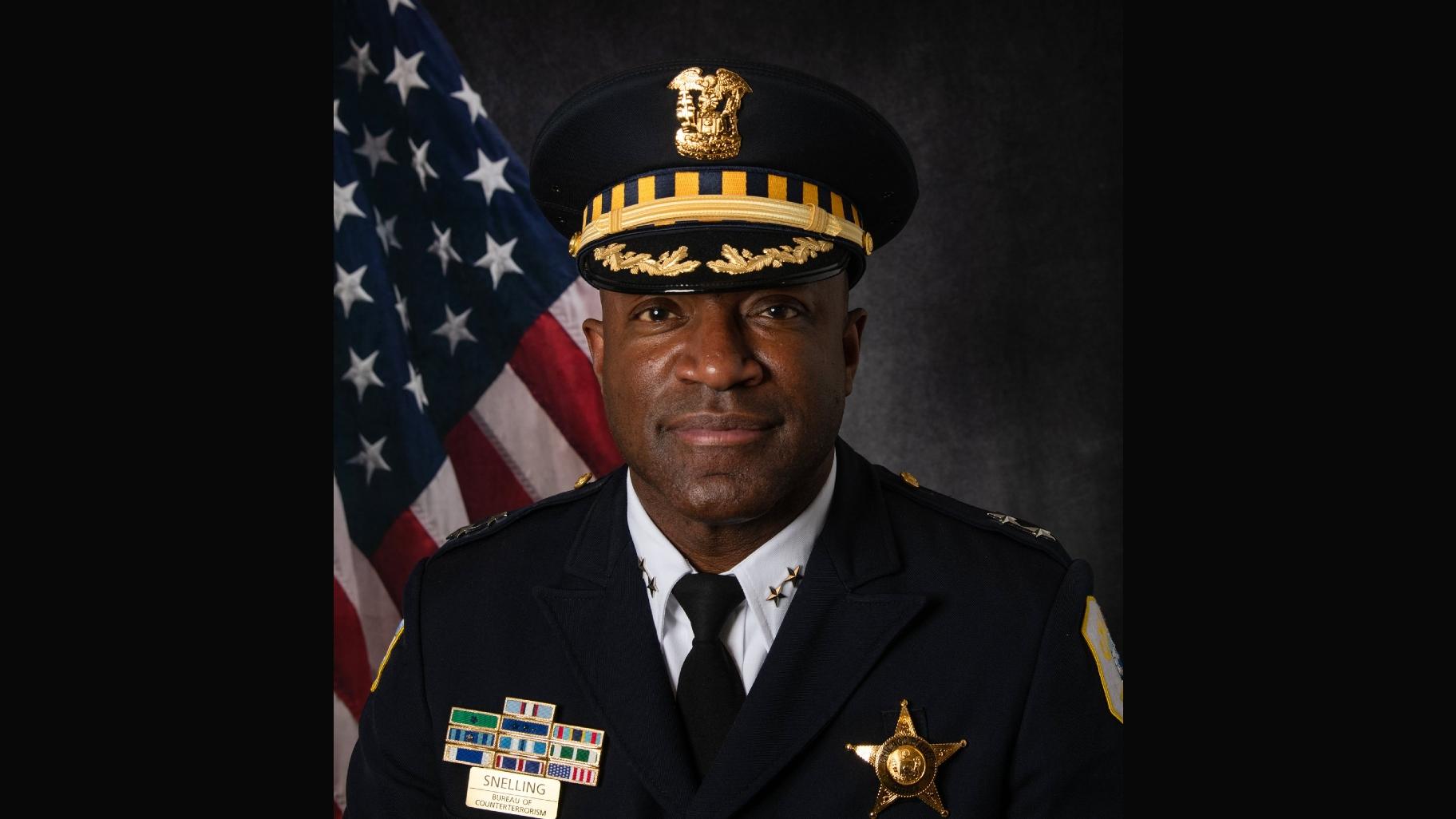 Larry Snelling (Credit: Chicago Police Department)
Mayor Brandon Johnson on Sunday tapped Larry Snelling, the head of the Chicago Police Department’s counterterrorism bureau, to become the city’s next top cop, charging the 31-year veteran of the scandal-plagued department with implementing a new approach to the surge of crime and violence that began during the peak of the COVID-19 pandemic and has yet to fully recede.
Johnson is set to introduce Snelling as his choice to lead CPD at an 11:30 a.m. Monday news conference at City Hall and make one of the most consequential decisions of his young administration official. Snelling must now be confirmed by the Chicago City Council.
Johnson called Snelling a “proven leader” who has the respect of his fellow officers, which is necessary “to help ensure the safety and well-being of city residents, and address the complex challenges we all face related to community safety.”
Snelling called the appointment a “tremendous honor” in a statement released by the mayor's office.
“It is also a tremendous responsibility, and one that I do not take lightly,” Snelling said.
Snelling was one of three finalists picked by the Community Commission for Public Safety and Accountability in July and lauded as a “generational leader” capable of “grappling with tarnished legacy of the past while charting a path for the future.”
In picking Snelling, Johnson passed over 22-year veteran Angel Novalez, now the head of CPD’s office of constitutional policing and Shon Barnes, the police chief in Madison, Wisconsin.
During the campaign for mayor, Johnson said he would prefer to name a new superintendent from within CPD’s ranks, calling it crucial for the city’s next top cop to be deeply invested in Chicago and familiar with how the department works.
Johnson has promised to re-envision public safety in Chicago to address the root causes of crime and violence by increasing funding for youth employment programs and expanding mental health services across the city. Johnson has also promised to solve more crimes by adding 200 detectives to the Chicago Police Department.
Snelling will not only have to ramp up reform efforts but also cope with persistently high rates of crime and violence on Chicago’s South and West sides.
 Chicago police Sgt. Larry Snelling testified during the trial of three Chicago police officers accused of trying to cover up the killing of Laquan McDonald on Wednesday, Nov. 28, 2018. (Zbigniew Bzdak / Chicago Tribune / Pool)
If confirmed as expected by the Chicago City Council, Snelling will be the fourth person to lead the Chicago Police Department in less than six months, capping a period of intense turmoil for the department. The mayor has to hope that his pick will fare better than the department’s last three leaders, who became political albatrosses for their bosses.
CPD has been without a City Council-confirmed leader since March 15, when former Chicago Police Supt. David Brown quit after former Mayor Lori Lightfoot lost her bid for reelection. Brown was replaced by former interim Supt. Eric Carter, who stepped down May 15, the same day Johnson took office. Johnson tapped interim Supt. Fred Waller, who resigned from the department in August 2020 after serving as the department’s third-ranking official, to replace Carter.
Waller, who earns $267,720 annually as police superintendent, did not apply for the permanent position.
The challenges facing the next leader of the 12,336-member Chicago Police Department are immense, and any honeymoon is likely to be short lived.
Not only will the next top cop face immediate pressure to reduce crime and violence across the city, they will also face prompt calls to swiftly implement the court order requiring the Chicago Police Department to change the way it trains, supervises and disciplines officers.
The city is in full compliance with approximately 5% of the 4-year-old court order, known as a consent decree, according to the most recent report from the team overseeing court-ordered reforms of the Chicago Police Department.
The next top cop must also work to craft a stable schedule for officers, ensure that response times are the same on the North Side as they are on the West Side and the South Side and reorient the department to ensure “real community policing,” according to Anthony Driver, the president of the Community Commission for Public Safety and Accountability, known as the CCPSA.
Snelling, 54, has led CPD’s counterterrorism bureau since September, after rising steadily through the department’s ranks.
Snelling also served as deputy chief of Area 2, which includes the Far South Side of Chicago, as well as the commander of the Englewood (7th) Police District and worked as a sergeant at CPD’s training facility.
Snelling was suspended twice during his 31-year career, according to a database compiled by the Invisible Institute. In 1994, a use-of-force complaint resulted in a two-day suspension for Snelling, according to the database. In 1995, he was suspended for five days in connection with a complaint that alleged his conduct while off-duty violated department rules that prohibit officers from associating with those convicted of felony offenses.
A native of Englewood, Snelling was also featured in a video in March 2021 designed to encourage Chicagoans to apply to be an officer. Snelling said he decided to be an officer after looking up to the officer assigned to his high school who became a father figure and role model to him and other teens.
Contact Heather Cherone: @HeatherCherone | [email protected] | (773) 569-1863